Japanese Cotton Cheesecake
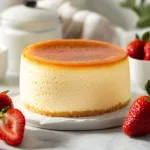
A light, fluffy, and incredibly delicate cheesecake that melts in your mouth, perfect for any special occasion.
- Prep Time: 30
- Cook Time: 75
- Total Time: 105
- Yield: 8 servings
- Category: Dessert
- Method: Baking
- Cuisine: Japanese
- Diet: Vegetarian
Ingredients
Scale
- ¼ cup (30 g) cake flour
- 2 tablespoon (20 g) cornstarch
- ¾ cup (180 g) cream cheese full fat brick
- 2 tablespoon (30 g) unsalted butter room temperature
- 3 ½ tablespoon (50 g) milk full fat
- 3 large egg yolks room temperature
- ½ teaspoon (2 g) vanilla extract
- 3 large egg whites room temperature
- ⅓ cup (70 g) granulated sugar
- ½ teaspoon (2 g) lemon juice
- powdered sugar garnish
Instructions
- Preheat your oven to 300°F (150°C).
- Line the bottom and sides of a 6-inch round baking pan with parchment paper.
- Fill a small saucepan halfway with water and bring it to a boil to create a double boiler.
- In a mixing bowl that fits over the saucepan, add the cream cheese, butter, and milk.
- Whisk the ingredients until the butter and cream cheese are completely melted and combined, reaching approximately 130°F (55°C).
- Remove the cream cheese bowl from the heat.
- Whisk in the egg yolks until fully combined.
- Whisk in the vanilla extract until fully combined.
- Using a fine mesh sieve, sift the cake flour into the cream cheese mixture.
- Sift the cornstarch into the cream cheese mixture.
- Whisk the batter until it is smooth and lump-free.
- Pour the batter through a fine mesh sieve into another bowl to ensure it is completely smooth.
- In a large, clean mixing bowl, add the egg whites.
- Add the lemon juice to the egg whites.
- Using an electric hand mixer, beat the egg whites on high speed until they become white and frothy.
- Slowly pour in ⅓ of the granulated sugar while the mixer is running.
- Continue mixing and slowly add the remaining sugar in two more batches.
- Beat the meringue until it reaches medium-soft peaks; the peaks should fold over slowly like soft-serve ice cream when the mixer is lifted.
- Turn the mixer to low speed and mix the meringue for an additional 30 seconds to remove any large air bubbles.
- Take ⅓ of the prepared meringue and gently fold it into the egg batter until it is completely combined and smooth.
- Carefully pour the egg batter mixture into the remaining meringue.
- Gently fold the batter with a rubber spatula until just combined, being careful not to over-mix or deflate the air.
- Pour the batter into the lined 6-inch baking pan from about 5 inches above the pan to help release any remaining large air bubbles.
- Place the cheesecake pan into a larger, deep baking tray.
- Fill the larger baking tray with about 1-2 cm of hot boiling water to create a water bath.
- Bake in the preheated oven at 300°F (150°C) for 30 minutes.
- After 30 minutes, lower the oven temperature to 230°F (110°C).
- Bake for an additional 30 minutes at the lower temperature.
- Increase the oven temperature to 275°F (135°C).
- Bake for another 13-15 minutes, watching closely to prevent cracking. If cracks appear, slightly crack the oven door for about 5 seconds to release steam.
- The cake is done when the top is golden and a toothpick inserted into the center comes out mostly clean.
- Turn off the oven once baking is complete.
- Leave the cake in the oven with the door slightly cracked for 15 minutes.
- Remove the water bath from the oven.
- Leave the cake in the oven for another 15 minutes to cool further.
- Remove the cake from the tin.
- Place the cake on a wire rack to cool completely at room temperature.
- Sift powdered sugar on top of the cooled cheesecake before serving.
Notes
Ensure all cold ingredients like eggs and cream cheese are at room temperature for best results.
Do not overmix the batter once the meringue is folded in; gentle hands are key!
The water bath is essential for a moist, crack-free cheesecake.
Allow the cheesecake to cool gradually in the oven to prevent shrinking and cracking.
Find it online: https://thecozycuppa.com/japanese-cotton-cheesecake/